Funny Super Smash Bros Tumblr Did You Know Gaming
-
December 9: DLC Part 3: What Reggie Said
Okay, so let's start off by getting that one piece of misinformation out of the way. Reggie didn't say all the DLC characters would be from new series; he said "these are going to be characters who are new to the series, just like Joker from Persona 5. Characters you would not anticipate to be in Smash Bros Ultimate." However, it's easy to understand why people made that assumption, myself included. Reggie's statement is clear tonally: these are characters who will be unexpected, wild, and alien to Smash. That sounds not unlike new series to me.
…Or does it? This isn't going to be a long thing, but I do want to think about a few ways his statement could be interpreted, as well as how plausible or strong those interpretations seem. So, here we go.
- The DLC fighters will not only be entirely new to Smash, they will be so much so that their franchise has never been represented in any capacity. In other words, this would mean either all third party characters - "just like Joker from Persona 5" - or a character from a new Nntendo series. To my knowledge, though, we don't know of any new IPs the company might have beyond Town, and otherwise unrepresented series might be limited to Dragalia Lost.
- The DLC fighters will have had no presence in Smash, "just like Joker from Persona 5," but that doesn't mean the same is true of their series. There are plenty of series in this game which have dozens and dozens of characters, many of which aren't in the game at all. More precisely, this opens the door for new characters from, for instance,Pokémon or Fire Emblem characters. These would be exciting just on the basis that they're completely new.
- The DLC fighters are just all newcomers, "just like Joker from Persona 5." It is possible that Reggie, skilled promotor that he is, just means that the characters are newcomers, which in and of itself is still a big deal. It's very likely a large number of players, potential or otherwise, haven't necessarily realized that all the DLC characters will be new (yes, even with the "everyone is here" marketing). Reggie made a point in that Game Awards interview to say people should feel confident buying the Fighter's Pass, something at odds with Sakurai's statement; he is still selling it.
- The DLC fighters, "just like Joker from Persona 5," will be especially surprising. This is the take I'm thinking about more right not, though once again, it could just (and probably does) fall into marketing copy. Part of the other potential of DLC is doing things that couldn't be done in the base game, like out there newcomers. This could mean that popular characters with negligible presence on Nintendo consoles are possible, for instance. Or hell, maybe they won't have any, like 2B from Nier: Automata.
The latter point is really important, given another interview he recently gave with IGN:
Mr. Sakurai, he's not only a student of Nintendo franchises, and obviously he's had his hand in a few, but he's a student of video games from a total perspective," Fils-Aime said. "And so he's been the driver in really thinking about what type of character coming into Super Smash Bros. Ultimate would bring just a whole different level of fun and enjoyment for the player. That's been the approach. That's the thinking."
This quote is really telling: characters from a "total" perspective pretty much means third parties, doesn't it? Sakurai himself has said that while he might have had misgivings had Cloud never appeared on Nintendo at all, it wasn't outside the realm of possibility.
Of course, this may all be bunk. We know Nintendo chose the DLC characters, so Reggie's probably fibbing a bit at least in one part of the interview (because, let's be fair, "our corporation chose this character" is less exciting than "our brilliant auteur chose this character"). He's a showman playing up the game because that's what you do when you're at the Game Awards the night one of your three biggest blockbusters of the year comes out. No matter what, though, I think we should view Reggie's statement as explicit: surprise, and breadth of the gaming world, is the name of the game. I think it's best to - at least a little - orient ourselves around the kind of thinking.
(Link to my writings on Super Smash Bros. Ultimate)
-
December 7: The Future
Okay, first things first; mea culpa. I drastically underestimated the size and difficulty of actually doing the final work in preparing my Smash Bros. retrospective. It is actually up now, though; if you've enjoyed my writing here and are okay with an, um, thirty thousand word piece of work, then I do highly recommend it. Anyway, after nine months, the game is out. I've been deeply enjoying it, I imagine many of you are as well, but I do think it would be good to quickly look to the future. Well, the future of this blog, anyway.
Like I said in my last post, I'm not planning on writing anywhere near the level I was for this. I'm not gonna show up five nights a week; I'm probably not likely to show up more than two at most. Even then, I'm typically worse at keeping regular blogging up when there's no real ending point - I mean, that was the idea here; write until the game comes out, and likely not much past that. Realistically, I'll probably write two more posts and then give up as the fatigue from the entire hype cycle only sets in further. That's what's happened a lot before, and after all the writing I've done for this game, I'm just looking forward to putting the work on hold. However, I'm sure I'll have stuff to say about the game going forward (i.e. yeah, we do kind of have to talk about Joker at some point).

This isn't goodbye or anything, though it is far more than possible my interest in having any sort of presence just completely collapses after this. But I would like to keep writing, albeit on a significantly slower pace. And by that, I mean it would not be regular at all. So I guess instead, consider this a "thank you" for reading my work, and a non-committal farewell. I'll maybe (hopefully?) still put out posts whenever I feel inspired to write something, but I want to keep myself far away from the world of daily posts. And really, I just want to enjoy this game now. I think that's something we could all use. So…I guess see you when I see you.
(Link to my writings on Super Smash Bros. Ultimate)
-
December 5: Summing Up This Journey
Remember the giant flame? Remember when we were trying to figure out what would be different in this iteration? Remember when we wondered about cuts, or were questioning who would be the surprise character, or how different Link would be in his Breath of the Wild form? I hardly even do by this point. It's been such a blur since November, and then since August, and then since June, and then since March. The hype train apparently does not actually end.
This - and just to be clear, this is a "my thoughts" post, not anything cogent about Smash - has been a wild and unbelievable trip for me. This has to be the most writing I think I've ever put out in my life by an obscene level. The two hundred-plus posts is absurd; it's about as much as all the Smash related blogging I did for this account put together. It was difficult, frankly, even painfully so at points. There is minimal chance I'll ever do a daily blog of this size again; it took real effort, and I struggled to come up with exciting and funny and intriguing topics each night (note that I say "night" and not "day;" a lot of these kept me up at night reveling in ideas about characters or modes). I'd advise any reader to think clearly and seriously about how much of their time, mind, and soul into a daily blog, especially if it's throwing out six paragraph posts a night. Restricting myself to three for the character ones was a big part of why they were higher quality than my other pieces; I had to limit myself.

Eventually, it came to the point where I couldn't keep up the energy for a serious, daily output. My work was getting too serious, my critical ambitions in other areas (a few months ago, I started doing reviews for Assassination Classroom; it was so exciting working on something so far afield of games). And when I started work on my gargantuanSmash retrospective - which will come out on December 7; I'll link it here - it was just too much to do it all. I am sorry I've not been posting here nearly as often as normal. It's just that some of the other work had to come first.
At the same time, this was an incredible journey in other ways. It was deeply rewarding seeing people like and respond to my posts, and it was really cool hearing people's ideas and thoughts. And getting all these for a game that looks as great and wild and frenetic as Ultimate is especially lovely. We're not getting this again, in all likelihood. And at least right now, I can't imagine pushing myself into doing another blog as time consuming as this; I certain'y can't seeing myself do this again, older and more tired. So I'm glad those two parts collided. It feels right. I know those TV show write ups weren't as interesting to people, and I know why, but they were insanely fun for me (I was planning that Rocky & Bullwinkle one for literal months). And honestly, I'm pretty confident that all this work has drastically improved my writing. In general, I like to think that every thing I write and create makes me stronger, giving me greater empathy and intelligence and skill. And I'm pretty sure this has helped me so much with that.
So I guess that's where I'm at. I'm excited, and happy, and content, a bit melancholy, pleased, proud, and more than almost anything utterly exhausted. It'll be bizarre actually playing this damn thing on Friday / tomorrow night, and not speculating on it. But tomorrow afternoon, I'll be back to talk about what the future may hold for this blog. I'd love to hear your thoughts, but if I'm being honest, I really always do.

(Link to my writings on Super Smash Bros. Ultimate)
-
December 4: So, What Comes Next for Smash?
We're all thinking it at least a bit, aren't we? As exciting as the just about to happen release of Ultimate is, and as intriguing as the mysterious DLC characters are, we all know this isn't the end for Smash. It's probably not the end for Sakurai as its primary creative force. And yet, things are going to have to change.
Sakurai has spoken extensively about how just adding more and more characters has limited appeal after a certain point, and that sentiment has a great deal of artistic worth and legitimacy. It also does not even include the basic fact that making characters is hard, and at some point you just can't keep going. I mean, these games have to actually exist in a physical sense after a certain point in development; Nintendo can't just keep it in the oven forever. And assuming everything goes on track, Ultimate will end with eighty-two characters. That's literally over double the size of the Brawl cast. It's almost obscene. This can't happen again, not because this is bad or because bringing back every fighter was wrong (it was a great, more than legitimate decision), but because it is simply logistically implausible. Note that I did not say "impossible;" stranger things have happened. But it's not really fair to expect Sakurai and whoever he works with to be able to keep up that pace.

Because of all this, we all recognize that the next Smash will almost certainly have to be radically different. Maybe it'll cut well over two thirds of the cast, or have mostly new characters? Maybe it'll keep the roster, but only by downgrading the mechanics and graphics entirely, turning it into a different type of fighting game entirely (yeah, I don't think this is happening)? Maybe it'll be just a reimagining of the first game, or have all new characters, or actually be a different genre? But any version of this game cannot have a roster this large and a game this gigantic, at least in the way we know Smash rosters.
Ultimately - pun not intended - Smash can't continue down this track, for a number of reasons. And yeah, that does kinda suck. But that can also be pretty cool. If the series dramatically reinvents itself, that could be fun and fascinating in a way. Maybe those bizarre, radical reinventions will turn out just as good? We will see a change at some point with this series, one in which some things we love will be excised and others will be drastically altered. So just be open to whatever comes next. We've still got Ultimate; it'll be around even when the next thing comes along. Change can be a true blessing, and if this series has taught me anything, it's that challenging assumptions and preconceptions can be wonderful.
(Link to my writings on Super Smash Bros. Ultimate)
-
November 30: Smashing the Wait: Rocky & Bullwinkle
When we last left our hero, Woflman Jew was careening down the slopes of Mount Martagon, attempting to finish typing his blog post with his hands while simultaneously attempting to use his feet to drive his promotional refrigerator, which had been bisected by an industrial…
Oh, right. Rocky. Well, let's start.
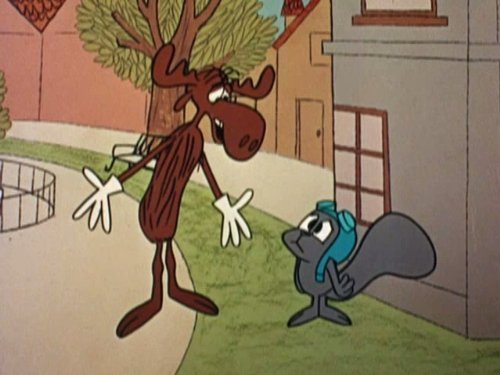
Only originally lasting from 1959 to 1964, The Adventures of Rocky and Bullwinkle and Friends - though if you're interested in looking it up, the show was first titledRocky and his Friends on ABC from '59 to '61, then The Bullwinkle Show from '62 to '64 on NBC - is one of America's more bizarre cartoon staples. The most famous show by animation legend Jay Ward (though the characters were co-created by his then-partner Alex Anderson, who got shut out of the franchise), it's a show that aggressively, often hilariously defies easy explanation. But at its core, it's two genres - a variety show and a breathless radio serial - and two characters. Rocky the Flying Squirrel (June Foray) was diligent, heroic, committed, and loyal to the American Way. His pal, Wossamotta U. alumnus Bullwinkle J. Moose (Bill Scott) tried but could only match the last of those qualities; he was incredibly strong but painfully thick (like, "actually one of the dumbest characters in American TV history" thick). And the two of them would invariably get caught up in shenanigans that'd take them from their home in Frostbite Falls, MN to the ends of the earth. Though they were often blissful to most of it, America was constantly in danger from the evil machinations of those
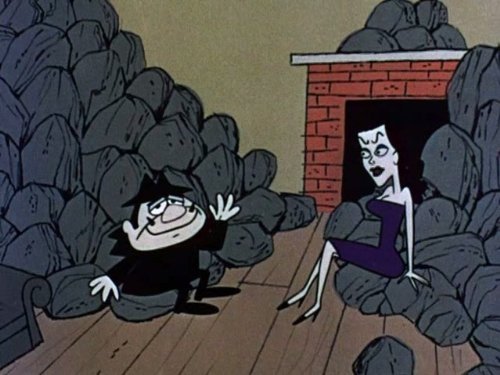
SovietPottsylvanian spies, criminals, terrorists, scoundrels, con-artists, and nogoodniks Boris Badenov (Paul Frees) and Natasha Fatale (Foray).The first (and probably most iconic) story should give a good idea. Bullwinkle's grandmother's fudge cake recipe turns out to be a powerful rocket fuel; the two animals then get recruited into the U.S. Army's Department of Guided Moosles, suffer threats from moon men scared that cheap space travel will fill their home with tourists, accidentally evade Boris' many attempts to kill "moose and squirrel," and go across the world - and into Pottsylvanian territory - to grab a recipe necessary fruit bush. But all of them are like this, really. Bullwinkle inherits a mysterious mountain which turns out to contain the world's only supply of the gravity defying upsidasium. Boris and Natasha's fearless leader, Fearless Leader, tries to trick Bullwinkle into finding the magical derby hat that turned Caesar, Genghis Khan, and Elvis into the smartest men in the world. After armies of giant metal mice eat the nation's TV antennae, Americans threaten to emigrate en masse to nations with better reception, a plot which would leave Boris and Natasha as the only people left. Another time, the two almost destroy the world's economy by drastically inflating the world's boxtop supply with counterfeits, and Bullwinkle (who saves all his boxtops; why wouldn't he?) gets arrested as the culprit. Every plot save the conclusion had a cliffhanger, with the heroes in peril from dangers as simple as a guillotine and as complex as a robotic super-whale.
But Rocky isn't just that; it's a five-part variety show, with the main "Rocky the Flying Squirrel" portion taking up the first and last segments. The second was for the classics; either "Fractured Fairy Tales" or "Aesop and Son" would tell an ironic story about incompetent witches, damsels, princes, animals struggling through, upending, or railing against fairy tale tropes. The middle one let Bullwinkle incompetently explore the finer things through "Bullwinkle's Corner" or "Mr. Know-It-All," a poetry slam in the former and "advice" on things like "how to teach a mean bully a lesson at the beach" or "how to disarm a live 5000 megaton TNT bomb in your own workshop in your spare time to amuse your friends" in the latter. The fourth would show one of the other two main parts of the franchise. In "Peabody's Improbable History," the eponymous Renaissance dog and his pet boy, Sherman, would travel through time in his "WABAC Machine" and aid the great men of history, all of whom are too incompetent to do whatever it is they're famous for without being guided by the nose by a painfully smug pooch. The silent film inspired (but still very talkative) "Dudley Do-Right of the Mounties" serials told the travails of 19th century Canada's most incompetent mountie, who'd almost accidentally defeat the vile Snidely Whiplash and save the damsel Nell, who only had eyes for Dudley's more talented horse, Horse. Then it'd be another "Rocky" and its cliffhanger ending before the two stars credited "some of the people who made this show impossible."
I used the word "incompetent" three times in the last paragraph, and the repetition is arguably necessary. Rocky is not necessarily mean or cynical, but it takes great pride in knocking virtually everything it sees down a peg or two. The asinine spies of the Soviet Union are more threatening to each other than it could ever be to us. The world's military leaders are boobs (one recurring "Rocky" character was Capt. Peter Peachfuzz, genetically wired to be incorrect about every subject and decision but too high ranking to not get constant promotions anyway); the same is true for the useless "heroes" of history. Smokey the Bear is one act of hypnotism away from turning into a violent pyromaniac. Marlon Brando's method acting is an absurd joke, and Charles Atlas was a con man (okay, those two are kinda true). It's even got a metric ton of morbid jokes: about suicide, being frozen alive or decades, Soviet gulags, executions (Boris on Fearless Leader: "he's doing a guest shot in this sequence. [BLAM!] There goes a guest now!"), and a nigh endless supply of violent murder plots by the two spies. One arc even ends with a bound Boris shaking with fear and forcing a smile before being shot offscreen by a firing squad, though thankfully he'd return with no explanation. None would ever be needed.
The thing, though, is it's not at all aggressive like some channer edgelord, and it doesn't take the self-satisfactionSouth Park takes when it does the same thing. It's just that in this world, there is nothing above being deflated by a pun, finger point, or morbid joke. Pottsylvanian society isn't just evil and surreptitious, it's dementedly so; all phone books are blank and newspapers nothing but ads due to all information being a commodity, their anthem glorifies literal badness, and words used to describe moral traits are harsh language. Thinly veiled pastiches of real people and midcentury TV producers go by so fast it's almost impossible to catch them, and the show is inundated with stupid puns. One "Rocky" arc about a commandeered WWII fortress is is titled "The Guns of Abalone," each "Peabody" segment ends with him making a joke so bad the show plays a tuba note off key, and almost every single "Rocky" segment has not one, but two terrible puns for titles. It's a devil-may-care attitude that even extended into the real world; to promote a storyline involving "Moosylvania" (an island the U.S. and Canada disputed over, as neither wanted it), Jay Ward had the staff rent an island between the border and started a "campaign" for its independence. Unfortunately, his short-lived plan reached its apex on the first day of the Cuban Missile Crisis. The dumb jokes hide an intense brilliance that shines from some incredible writing, frenetic plotting, and especially an ear for dialogue (sadly, the show's intelligence doesn't extend to a pretty ugly depiction of race, especially when Chinese Native American characters get involved in the plot).
See, what makes Rocky special isn't its visuals, which are great in their low end roughness but were a target of mockery even from its inception; in the 2000s, Looney Tunes' Chuck Jones once described it as a bunch of people who could write great scripts but didn't want to animate them. It's the voice. The show had many, all excellent narrators, most famously Edward Everett Horton as himself for "Fractured" and William Conrad for "Rocky." And they also weren't above reproach, at times getting in fights with the cast (Boris at one point threatens Conrad with a gun; in another he rewinds the episode to hear narration that could harm Rocky). That emphasis on narration was a product of the show's interest in radio drama plotting, a distinct and energetic style of storytelling that it put on laughing gas. The cheap animation was ultimately just a pleasingly cruddy avenue for putting out as many weird plots, dad jokes, and goofy ideas as possible. The actors, Foray especially, are amazing; the voices are so instantly iconic, memorable, and influential that even if you've never watched an episode or heard the actors, you probably know them. And that's really true in general; despite being this oddity that never matched the grandeur of Disney (also an occasional target of some elbow ribbing) or the ubiquity of Hanna-Barbera (which unfortunately escaped the same elbow), it's endured forever in the U.S. After it was cancelled, NBC still played it in syndication for decades, something done later by Nickelodeon and Cartoon Network in the Nineties. It's an obvious influence on a huge swath of American animation, and I'm a pretty certain Homestar Runner counts within that. And throughout a litany of critically and commercially failed reboots or adaptations, the original version, dated as it is, has endured a surprising amount. It's deserved.
Why Should Super Smash Bros. Fans Watch it? This might just be me, but there's a part of me for at least the last two iterations of Smash that's felt like I'm aboard a train careening off its rails. Not in a bad way, mind; there's just always a sensation that some game mode or feature or…something is going to backfire, or shock in a way that's not meant as intended. I talk about this all the time, but it's that surprise and sense of insecurity that make these games so exciting. What's Sakurai gonna do next?
Rocky & Bullwinkle was essentially built on that, possibly nothing but that. Just in general, the entire show feels like it was made on a breathless race against inevitable cancellation; even if the middle and later episodes didn't have the occasional gag about how they were about to be cancelled, the demented pace gives it away. But the plots are wild, the stories bizarre, the puns beautifully strained, and the sense of abandon reckless. If you like that part of Smash the way I do, it's not a bad idea to check out some Rocky episodes. Hell, you don't even need to see them in order. But it's there for when you'd like a bit of happy, blissful chaos.
Well, that's all the time we have left. Be here next time, For: "The Ghosts of Macho Pichu," OR "Villager Chops to It."
(Link to my writings on Super Smash Bros. Ultimate)
-
November 29: My Philosophy
On the night of November 1st, I spent hours into the night chatting with some of my closest online friends about Smash. We geeked out over Piranha Plant and Incineroar, discussed the potential of World of Light, and for a bit talked about the general Smash community. For one part of the latter, we mulled over the odd culture of character-specific campaigns and support groups. And while we were talking about it and possible future characters who might be potentially more or less interesting or valuable, one of them described me as (and I'm paraphrasing what she said a bit) "one of the most open people towards new characters I know." It was really nice of a thing to hear, and I've thought about it every so often for a lot of this month. This post is going to be one big ego trip, but I would like to think a bit about why I approach newcomers in the way I do.
I've talked about this before, but Smash 64 and Melee had a profound effect on me as a kid. So when I really came back to Nintendo (and video games in general) in late 2005, the prospect of a third game, one even greater in size and scope than the last, was immensely exciting. The first Smash game made me love Kirby, but before my departure I only playedKirby 64; coming back, I jumped into Kirby & the Amazing Mirror - and from it, met Meta Knight. His cool style, plus my general enthusiasm for Kirby, made him pretty much immediately my most wanted character. He wasn't the only one: Dedede, Lucario,
ToonWind Waker Link, Paper Mario, and Ridley were all exciting, especially as I started lurking on the hellscape that is Smashboards. But it was Meta Knight above everyone else, without question.
And wouldn't you know it, but he was the very first newcomer. There were, of course, other characters and stages and music I wanted, some of which happened and some of which didn't, but I was left now with an odd sensation of kind of full-on satisfaction. It was like I was being catered to directly, so my excitement then came just as much from unexpected things as they did from what I wanted. Lucario was cool, but a wild moveset from Olimar was almost better. I hoped for aYoshi's Island stage, but one based on the original Donkey Kong was so exciting in a way that couldn't match. And the music! I started to get just as (if not more) interested in exploring the new tracks as characters, and those helped get me into some of Nintendo's games with which I was less familiar. I wonder if, without a huge desire driving me more, all the new content made felt more…exciting, almost like a bonus? Then again, I suspect my attitude is actually matched by the vast majority of Smash players; they see a game that looks fun with some characters they love, and that's it. And it's something that's not really changed sinceBrawl. My most wanted newcomer for Smash For was "come what may;" my three for Ultimate ended up being "a female fighter who wasn't an Echo, a Pokémon, and "something surprising," and I only landed on those after the August Direct. There haven't really been characters who frustrated or upset me, and even thinking of fighters I explicitly do not want is hard. The real chase I get is from excitement and surprise, and that needn't be limited to characters. Because of that, each incoming Smash game feels like a holiday, constantly doling out expected and surprising gifts. Each game deserves to be challenged, criticized, and interrogated, but none exist to provide solely only one new idea or element.
I do think that while it's neither unique to me nor something that needs to be emulated, the philosophy I've been subconsciously developing over the past decade has made my relationship with Smash more positive and enjoyable. Few things are "make or break" for me, and while there are at least dozens of characters I'd especially love to have, each new one is exciting - especially ones I'd never consider. The most negative I've been about a newcomer was when Corrin's trailer started, and their gameplay mostly won me over by the time it ended. I think that there's a value in taking just a bit of distance, and especially in not putting all your hopes on one new (or returning) fighter. It also makes me feel as though Smash isn't made for me, or at least not specifically or exclusively so. And honestly, that feeling is deeply freeing. I've talked before about how some fans view this series as almost needing to be about them, but one corollary to that is that giving up a bit of that intensity cuts out a great deal of weight. I guess what I'm saying - and this is deeply hypocritical coming from someone who's written over two hundred posts this year (and over four hundred overall) about Smash on this blog alone - is that putting just a bit of distance, giving up just a bit of your hopes can be really helpful. And it can make new things feel more like a bonus and less like a potential threat. There really is a state of transcendence you can get after a point, I can promise you that.
(Link to my writings on Super Smash Bros. Ultimate)
-
November 28: DLC Part 3: the Upcoming Games
Now, there are gonna be a number of limitations here, but I think it's fair to say that Nintendo will likely be looking at a number of new or unreleased games for at least some DLC characters to advertise. I don't think that's all we'll get, but I'm confident assuming that will take up a bit of their attention. So, let's get to 'em - or at least the ones I can remember:
- Animal Crossing (though I'm doubtful this would lead to a character now that Isabelle's in)
- Fire Emblem: Three Houses
- Luigi's Mansion 3
- Metroid Prime 4
- Pokémon Gen VIII
- Town
- Yoshi's Crafted World (though I'm doubtful of this, too, given Yoshi has that new alternate costume)
You'll note all these are Nintendo-owned games. Personally, I'm a bit less of a believer in the possibility of upcoming third party games being included - at least, those that are new intellectual properties and not sequels - just because the rights and processes are weirder and more complicated. You can be more certain that, say, Animal Crossing will come out as something acceptable than a project not entirely or mostly under your control. Though there are also series likely to get a sequel within the next couple years, Kirby and The Legend of Zelda being the biggest. The latter especially could be a big deal, partially since I do think Nintendo will be at least somewhat biased towards the games it more fully controls (over, say, the ones owned by subsidiaries or developed by outside studios). And, there are of course several games we don't know about that are in production; there's a chance a fighter might be added before their game even releases, like what happened to Roy.

Now, the easiest way to read this would be through assuming that we'll be getting a character who's new, and I do think (at least) one of the fighters will have debuted next year, after Smash. Certainly a Pokémon character will be from the newest generation, for instance. But that might not be entirely the case. The best fit from the new Luigi's Mansion would likely be King Boo, assuming he's the bad guy again, just like how a new Kirby game would "probably" go with someone like Bandana Waddle Dee.
Again, I also do want to discourage assumptions that it'll be all advertisement for upcoming things. I'm comfortable assuming promoting new stuff will be a big part, but it might not be all. I do think Nintendo has an interest in adding a new fighter from a guest series. And they probably want to bring in some more classic characters who've not yet been in the series (Dixie Kong, Birdo, Bandana Waddle Dee) or more modern characters (someone from Rhythm Heaven or ARMS). In both Mario Kart 8 and Mario Maker, Nintendo has shown an interest in representing things both old and new. Classic and new characters were added as Kart racers (with most of the tracks being of classic games), and Mystery Mushroom costumes ran the gamut from has-been NES characters to gimmicky newcomers to classics used for anniversaries. So I do think it'll be at least a bit more equitable.
However, there will definitely be an interest in grabbing from a new game. There's gotta be; it'd be crazy if there wasn't. Fundamentally, the company is looking at DLC from a financial standpoint (it presumably trusts Sakurai and his team to make it artistically and structurally strong). It'd be financially smartest to try for every fighter to hit as many of those points we discussed in the last DLC post as possible, and grabbing from newer games is one not small part of that. So pay attention to the upcoming games, especially in Directs from early next year. The games shown off will have been in production for at least some time.
As one final thing, I'm sorry about having not been on nearly as much over the past week or so. It's just been hard thinking of new topics, and I've also been trying to work on my Smash Bros. retrospective.
(Link to my writings on Super Smash Bros. Ultimate)
-
November 24: How Has Adding Newcomers Changed?
This post will feature no information at all from the recent leaks for Super Smash Bros. Ultimate. I have, however, been looking into some of them, and how a few fans have taken the information to try to discern whether particular choices of spirits, bosses, or music point to any possible downloadable content. Again, this isn't about that. I won't be talking about what they're asking, the evidence being used, or anything of the sort. But their questions about characters have made me think of another question about what of Smash has changed.
Of course, virtually every aspect of what Smash is has changed, altered, or expanded over nineteen years; it'd be nuts if it didn't at least challenge itself. But specifically, I'm thinking of how it looked at characters. Let's look at it by game.
- Smash 64: the main franchises and icons that Nintendo had, at least at the time. With the exception of Fox (and beyond the importance of his game at the time, he's important just for his role in Smash), all of the original eight would have to be in any game like this. The other four are weirder, since they were chosen partially to take animations from the rest of the cast, but other than Ness they were iconic and important for the era.
- Melee: expanding the main series and filling in odd gaps.Mario, Zelda, and Pokémon surged with important and memorable characters, but most of the rest of the Melee newcomers were more odd or distinct. Having two Fire Emblem characters gave the biggest new series a bit more of an identity, Ice Climbers and Game & Watch ensured retro representation was a thing, but other major series like Donkey Kong and Kirby were left without anyone.
- Brawl: bringing in the final BIG icons while looking to the future. Wario, Diddy, Meta Knight, and Dedede were the most outstanding characters, while Sonic was needed just on a historical level. Meanwhile, newer characters like Lucario and Lucas represented Nintendo in the years after Melee came out. Throw in a couple characters with a strong name recognition like Pit, and you have a game that fills out the big gaps of the last while making a few gestures to a new direction.
- Smash For: newness, mechanical gimmickry, and a sense of uniqueness. Far more than the last game, we got new characters, ones who would end up partially defining where Nintendo would go in the years of the Wii U (hell, Greninja's now in a trailer for a Ryan Reynolds movie). There was also an interest in pushing the limits of what these characters could do, with Robin, Bayonetta, and Rosalina using wild movesets and mechanics. And with five third party characters, there was a clear interest in looking outside of the Nintendo norm. This was also furthered through the DLC.
- Ultimate: popularity and "importance," to Nintendo and "the fans." With the exception of Incineroar (and Richter, but he doesn't quite work as an example), every single fighter in the base game was highly requested, relevant, or with a modern presence - often with at least two of those values. The Echoes only further this, and with such a small amount of space for them, it's clear there was an interest in going all out in the fanservice. And yet, the first DLC fighter is an amazingly bizarre choice, and we've no idea of what Nintendo wants with the other five. So maybe we'll see an entirely different direction just for the DLC? It even matches the (non-Echo) newcomers from the base game for size, so contrasting them will be fairly easy.

Even without this, It's clearSmash is, and has always been, willing to change up how it approaches characters - at least, inclusion of characters - throughout each game. They're all treated as fighters first when actually in development, of course, but the process for considering them does change a bit each time. It means we can't treat each game as a clear blueprint for the next.
However, there are common themes that do run through each game: a desire for characters both old and new, an interest in mechanically unique fighters, an effort to buff pre-existing franchises, and at least some concern for the inclusion of new series. Those are all important; it'show important they are that differs for each game. And I think that if there is a way to predict Sakurai, it's through predicting that. Brawl came seven years after Melee, and Smash For came six years after Brawl. Those are the two most known for having mechanically unique and newer fighters, probably because they had so long to look at Nintendo change and shape. That's not something Melee or Ultimate (which, as planning started at the end of 2015, couldn't predict how huge the Switch would become) could do.
Admittedly, it's hard to predict how that will shape up with this period of DLC, but I do think looking at it in those terms will help for the next games. I think some direct patterns - one new Fire Emblem person, one new Pokémon person - are easy and sensible, but looking at why those changes in direction happened should be useful in the games to come.
(Link to my writings on Super Smash Bros. Ultimate)
- Smash 64: the main franchises and icons that Nintendo had, at least at the time. With the exception of Fox (and beyond the importance of his game at the time, he's important just for his role in Smash), all of the original eight would have to be in any game like this. The other four are weirder, since they were chosen partially to take animations from the rest of the cast, but other than Ness they were iconic and important for the era.
-
November 22: Smash Stuff for which I'm Thankful

Not a long post this time, but it is Thanksgiving. And, well, I thought it might be good for me to just step up and give some love to a few things about Smash Bros. I'm thankful for this year.
- Firstly, yes, I'm so thankful everyone is in. It's not a move I'd have made, but it's an honest to goodness miracle Sakurai and Namco managed to pull it off. And it was the right thing to do, I think.
- I'm thankful Ridley got in. Like, we really should not forget how - pardon the pun - huge of a deal that is. Adjusting for time, that funky space pterodactyl was the most wanted character in the series' history by a country mile. With him and second place contender K. Rool both in, we're nowhere near an obvious leader of the pack now.
- I'm thankful we've got a wrestler in Smash. I never would have put Incineorar over Decidueye (or a number of other Pokémon fighters, for that matter), but it looks so amazing.
- I'm thankfulCastlevania got its due with thirty-four damn pieces of music.
- Beyond that, I'm thankful for the eight hundred-plus songs. It's not evenly distributed at all, and there are definitely blind spots (so far), but it's legitimately incredible as a collection of music. There are normal remixes and rips, but also a ton of bizarre and wonderfully out there choices, and it all leads to something unbelievable in size and scope.
- As an addendum, I'm also specifically thankful we got "The Starship Sails" (or "Sky Station 2″), a Mario Galaxy 2 song I've wanted for so long I literally wrote about it in 2014.
- I'm glad people reached out to Nintendo about the racist Mr. Game & Watch animation, and I'm thankful they've responded by stating they'll edit it. There's still a Fire Attack spirit, and that sucks, but altering the attack itself is a much more important, and better, thing. It's something of which I'm deeply appreciative in a way that's hard for me to fully express.
- As a corollary, I'm thankful Leaf and Pikachu Libre are in. It's also cool there are two Villagers with darker skin tones, which (unless you count Pocket Camp) is something I believe Smash beat Animal Crossing to. We talk about Sakurai's interest in mechanical accessibility, but I think we ignore an interest on his part in other kinds of inclusivity.
- I'm thankful Hanenbow and Environmental Noises, the things no one but me likes, are both back. They're thematically relevant!
- I'm thankful Spirits looks incredibly fascinating and compelling. I was worried since E3 that Ultimate would just be a nostalgia trip (even by the standards of a crossover), but the little we've seen of it is just absolutely cool. This series never rests on its laurels, and that's also something deserving thanks.
- I'm glad people have become legitimately excited about Echo fighters, and have managed to mostly accept and enjoy the beautiful Piranha Plant. I don't think it's unfair to say that the fan outrage about character choices was still extreme at times this year, but it's nice seeing those two parts be treated reasonably well.
- And looking through all of these, I'm happy that I was blindsided by so many things, or proven wrong about others. This series gets a lot out of surprise and upending your expectations, even if Sakurai has stated that's not his primary interest. But it does happen, a lot, and it's nice to fall in love with things you disliked or distrusted.

More than anything, though, I'm thankful for getting to explore this game, and this series, with everyone here. It's been a legitimately exhausting experience, and one I'm not likely to try again, but I'm been enjoying reading responses, seeing how other people are interpreting the games, and just exploring what this series is and means. It's been a wild ride, and while I am looking forward to the end of both the speculation and my regular blogging, it has been and until the game's release will continue to be a treat.
What about anyone here? Any things about Ultimate that have made them especially happy or pleased?
(Link to my writings on Super Smash Bros. Ultimate)
-
November 20: Master Hand and the World of Toys
As I've been writing up this massive retrospective of Smash Bros. (due out the day Ultimate releases!), I've been thinking about the premise of this series. Specifically, I'm referring to theSmash conceit of characters really being toys under the dominion of a hand. Sakurai finally made this explicit in the most recent Direct, but fans have been discussing it for close to two decades. It's interesting, isn't it? I mean, functionally Master Hand represents the aspect of fans that wish to play with these characters, pitting them against each other with wild abandon. But in that case, why do the toys struggle? Hell, why are they even sentient (besides that it lets Viridi make fun of King K. Rool)?
It would be easy to look at the fighter / Hand dichotomy - and to be clear, I'm tabling Crazy Hand, Master Core, and the adventure villains - as being in reference to an artist and their art. Sakurai is, of course, working with his own creation, and so much of this series has come from him and his colleagues wrestling with the challenges that pop up out of it. You could also argue it as being about fandom. Fans are the ones demanding these characters be fighters and that each new game be of greater size, and they interpret these characters in ways Nintendo did not anticipate. But I don't think either of those are really it, and not just because Sakurai really isn't petty enough to want to insult fans. If the former does work, it's only because it's based around something as simple as this: the relationship between us and that which we all create.
So art is this bizarre thing. We have sentience, imagination, and desires that go beyond the corporeal world, so we draw and write and shoot and program our thoughts and feelings into a way that makes sense. We enjoy the art of others because they can speak to us or our emotional needs: to explore fear, thrills, righteous anger, loss, joy, arousal, or empowerment. Nintendo's games have done that for a lot of people, and it's led plenty of them - myself included - to burden some of their stories and characters with additional meaning. The characters take on a life from those they meet at every level of their existence; it's how we got Kaizo Mario and fan made EarthBound sequels and Bowsette and two rival Zelda timelines, one by Nintendo and one by fans. These aren't bad for the most part (well, maybe some of the fan Pokémon, Sonic OCs, and misguidedKaizo successors), and really, they're evidence of how great these can be. There's enough room in them for these interpretations.

I think Smash Bros. tries, albeit with minimal actual writing or storytelling, to express this fun and occasionally tense relationship. In a sense, we want to control these characters, not just playing them in battle but building them in the way we view them. But they get away from us, and perhaps in so doing show their worth and power. Playing in the "world of the imagination," where anything can happen and Waluigi can get in a fight with Rathalos from Monster Hunter while Simon Belmont and Pac-Man are trading blows, is great. But that greatness does have limits, for both us and these characters. Eventually, that does have to end, at least for a time. Ironically, these characters must fight to show themselves greater than just being fighters.
When discussing the Brawl version of Final Destination, Sakurai stated that the stage's background, which took players from a pitch-black galaxy to a realistic sea bathed in light, represented the game getting closest to a "real-world setting," and while the series' other Final Destinations lack that imagery in their backgrounds, it's always been in the name (or its Japanese one, "Ending Point," or even the term "Omega forms"). It's Smash at its most stripped down: a platform above an abyss, lacking in any embellishments or references. That's what matters, and while things are a little different in Ultimate given how the bosses work, it still mostly holds. For all that the game is a goofy crossover, it's those mechanical values that matter more than any reference (and even just by the standards of being a crossover, though values - Nintendo values - come first).
All of this is a pretty roundabout way to say that Smash games are about the relationship between us and the things we love, and the imaginary space in which it exists. Sometimes conflict arises from that, and sometimes it's not a bad thing. In a way, by going through these experiences we hopefully can conquer our own limitations, seeing these characters and our own enjoyment of them through a new and greater perspective. I know it's weird to think of Smash through these terms, and it's not really something many fans will care or think about. But there has always been an interest on Sakurai's part in looking at this kind of game through a different perspective. It shows, I think, part of the series' attitude in a different way.
(Link to my writings on Super Smash Bros. Ultimate)
richardhictfat1983.blogspot.com
Source: https://smashmusicideas.tumblr.com/
0 Response to "Funny Super Smash Bros Tumblr Did You Know Gaming"
Enviar um comentário